 KDE 3.5 API Reference
 kviewshell
ArrayBaseT< TYPE > Class Template Reference
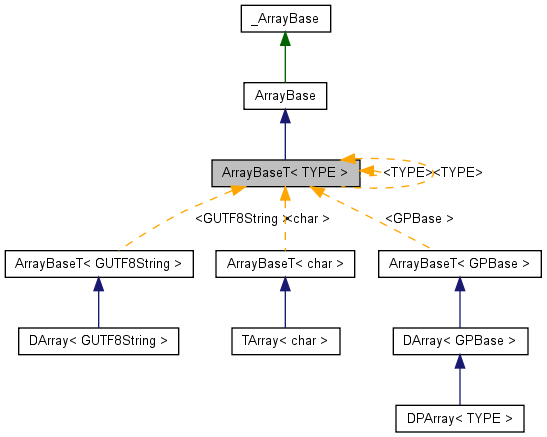
Dynamic array template base class. More...
#include <Arrays.h>
Public Member Functions | |
| void | ins (int n, const TYPE &val, unsigned int howmany=1) |
| operator const TYPE * () | |
| operator const TYPE * () const | |
| operator TYPE * () | |
| const TYPE & | operator[] (int n) const |
| TYPE & | operator[] (int n) |
| void | sort (int lo, int hi) |
| void | sort () |
| virtual | ~ArrayBaseT (void) |
Protected Member Functions | |
| ArrayBaseT (void) | |
Detailed Description
template<class TYPE>
class ArrayBaseT< TYPE >
Dynamic array template base class.
This is an auxiliary template base class for {DArray} and {TArray} implementing some shared functions which {depend} on the type of the array elements (this is contrary to {ArrayBase}). It's not supposed to be constructed by hands. Use {DArray} and {TArray} instead.
Definition at line 449 of file Arrays.h.
Constructor & Destructor Documentation
| virtual ArrayBaseT< TYPE >::~ArrayBaseT | ( | void | ) | [inline, virtual] |
| ArrayBaseT< TYPE >::ArrayBaseT | ( | void | ) | [inline, protected] |
Member Function Documentation
| void ArrayBaseT< TYPE >::ins | ( | int | n, | |
| const TYPE & | val, | |||
| unsigned int | howmany = 1 | |||
| ) |
Insert new elements into an array.
This function inserts howmany# elements at position n# into the array. The initial value val# is copied into the new elements. All array elements previously located at subscripts n# and higher are moved to subscripts n+howmany# and higher. The upper bound of the valid subscript range is increased in order to account for this shift.
- Parameters:
-
n subscript of the first inserted element. val initial value of the new elements. howmany number of elements to insert.
| ArrayBaseT< TYPE >::operator const TYPE * | ( | ) |
| ArrayBaseT< TYPE >::operator const TYPE * | ( | ) | const |
Returns a pointer for reading (but not modifying) the array elements.
This pointer can be used to access the array elements with the same subscripts and the usual bracket syntax. This pointer remains valid as long as the valid subscript range is unchanged. If you change the subscript range, you must stop using the pointers returned by prior invocation of this conversion operator.
| ArrayBaseT< TYPE >::operator TYPE * | ( | ) |
Returns a pointer for reading or writing the array elements.
This pointer can be used to access the array elements with the same subscripts and the usual bracket syntax. This pointer remains valid as long as the valid subscript range is unchanged. If you change the subscript range, you must stop using the pointers returned by prior invocation of this conversion operator.
| const TYPE& ArrayBaseT< TYPE >::operator[] | ( | int | n | ) | const |
Returns a constant reference to the array element for subscript n#.
This reference can only be used for reading (as "#a[n]#") an array element. This operation will not extend the valid subscript range: an exception {GException} is thrown if argument n# is not in the valid subscript range. This variant of operator[]# is necessary when dealing with a const DArray<TYPE>#.
Reimplemented in DPArray< TYPE >.
| TYPE& ArrayBaseT< TYPE >::operator[] | ( | int | n | ) |
Returns a reference to the array element for subscript n#.
This reference can be used for both reading (as "#a[n]#") and writing (as "#a[n]=v#") an array element. This operation will not extend the valid subscript range: an exception {GException} is thrown if argument n# is not in the valid subscript range.
Reimplemented in DPArray< TYPE >.
| void ArrayBaseT< TYPE >::sort | ( | int | lo, | |
| int | hi | |||
| ) |
Sort array elements in subscript range lo# to hi#.
Sort all array elements whose subscripts are in range lo#..hi# in ascending order. The other elements of the array are left untouched. An exception is thrown if arguments lo# and hi# are not in the valid subscript range. Array elements are compared using the less-or-equal comparison operator for type TYPE#.
- Parameters:
-
lo low bound for the subscripts of the elements to sort. hi high bound for the subscripts of the elements to sort.
| void ArrayBaseT< TYPE >::sort | ( | ) |
Sort array elements.
Sort all array elements in ascending order. Array elements are compared using the less-or-equal comparison operator for type TYPE#.
The documentation for this class was generated from the following file:
